Campus News, Media, Press Releases, Technology
MaKami College Opens its First HyFlex Classroom in Calgary
Sep
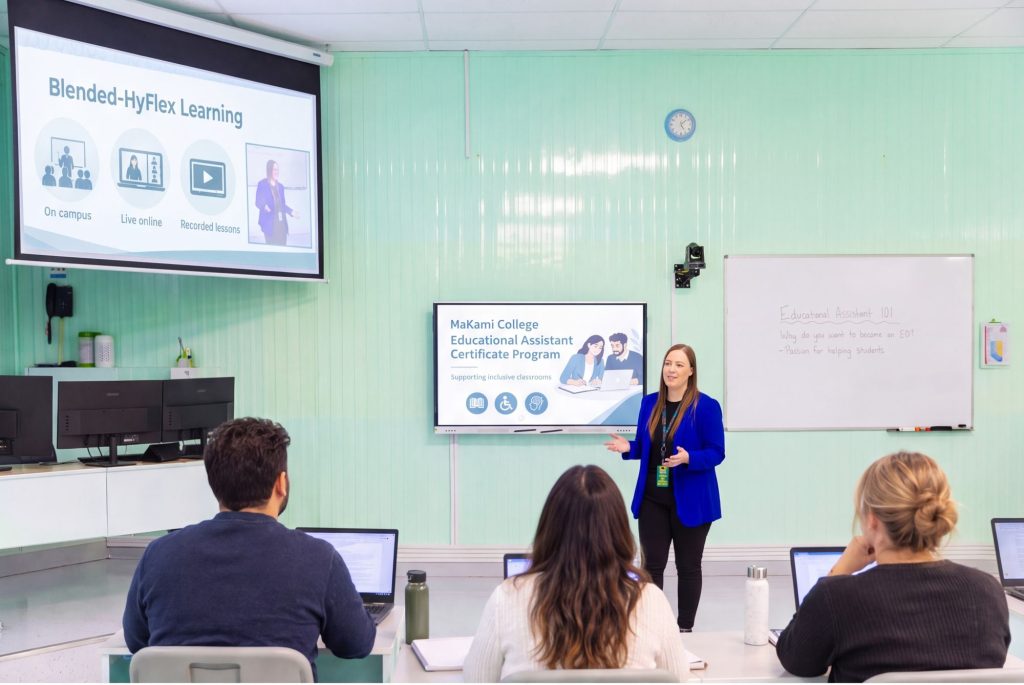
MaKami College opened its first HyFlex classroom at its Calgary campus in September 2026. The Educational Assistant certificate program will be the first program to use the new classroom as part of a pilot.
The classroom will give students three ways to take part in class. They can attend in person, join the live class remotely or access a recording afterward when permitted under course requirements.
Construction began in July 2026. The purpose-built classroom will include three cameras, multiple microphones, six monitors and a SMART Board. The technology will help instructors teach students in the classroom and online at the same time.
The project supports MaKami’s commitment to flexible and accessible education while maintaining instructor guidance, class discussion and opportunities for students to learn together.
What is a HyFlex classroom?
HyFlex combines “hybrid” and “flexible.” It allows students to participate in a course in more than one way.
Depending on a student’s learning preferences, a student may attend in person, join the class online in real time or review course materials and a recording later. Each option is designed to help students work toward the same learning objectives.
The approach recognizes that a student’s circumstances may change. Work, family responsibilities, illness, transportation or an unexpected interruption can affect a student’s ability to attend class in person.
A well-designed HyFlex course gives students another way to remain connected without treating remote participation as an afterthought.
MaKami’s new classroom will bring in-person and remote students into the same live learning environment. Cameras and microphones will help remote students follow what is happening in the room. Classroom monitors will also help instructors see and communicate with students joining online.
Through innovative course design and instructor delivery, students will still be able to engage with each other regardless of their preferred mode of delivery. And the Educational Assistant students will be experiencing first-hand some of the technology and learning experiences they may be assisting their future students with after graduation.
Why flexible learning matters
Many post-secondary students balance school with employment, caregiving, transportation and other responsibilities. Flexible participation can help students continue learning when attending campus is difficult.
Research also shows that flexibility alone does not create a strong learning experience. In a 2023 study involving 876 students at a public four-year university, 70% used the flexible participation option. Students valued its convenience, choice and time savings. However, they reported lower satisfaction in areas such as peer connection, moving between participation formats and technology performance.
These findings show why course design matters. HyFlex learning requires reliable technology, accessible course materials, clear expectations and opportunities for students to participate wherever they are.
Resources developed by post-secondary institutions such as Columbia University and the University of Missouri also emphasize active learning, timely instructor interaction and comparable opportunities to meet course objectives across participation formats.
Students gain more choice in how they stay involved. Instructors can extend live teaching beyond the physical classroom while continuing to build a connected class community.
Starting with the Educational Assistant program
The first pilot will take place in MaKami’s one-year Educational Assistant certificate program.
The program prepares students to support diverse learners in complex classroom environments. Students develop skills in inclusive education, academic support, behaviour management, assistive technology and the practical use of artificial intelligence.
The program also includes three work-integrated learning courses, including 225 hours of practicum experience.
Learning in a HyFlex environment connects naturally with the work educational assistants may perform. Graduates may use assistive technology, flexible instruction and inclusive strategies to help students participate in classroom learning.
The program also incorporates elements related to Universal Design for Learning, trauma-informed practice, belonging, equity and collaboration.
Experiencing flexible learning as students can help future educational assistants understand how classroom design affects participation. The HyFlex classroom will support live instruction. It will not replace practicum experience, in-person learning or collaboration with classmates.
Building on MaKami’s investment in technology
The HyFlex classroom builds on MaKami’s work to use technology in support of learning and student success.
In 2025, the college opened a computer lab at its Calgary campus, and plans are underway to build a similar lab in its Edmonton campus. The lab offers digital literacy and Moodle workshops, one-on-one technology support and technology intended to assist persons with disabilities.
MaKami has also contributed to research involving augmented, virtual and mixed reality in hands-on education. Work with the University of Calgary has explored ways to support tactile learning in remote education. A research collaboration with the University of Tokyo has examined the use of 3D depth cameras, remote interaction and co-presence in educational settings.
The HyFlex classroom is a separate project, but it follows the same principle: technology should make learning more accessible, interactive and connected.
Supporting MaKami’s Values
Innovation and technology are two of MaKami College’s core values. The new classroom puts those values into practice by expanding participation options and supporting interactive instruction.
The pilot also connects with MaKami’s focus on learning excellence. The college will use the pilot to learn what works well and where students or instructors may need additional support.
What comes next
Educational Assistant students at MaKami’s Calgary campus are expected to begin using the HyFlex classroom in September 2026.
The pilot will help the college better understand how HyFlex teaching can support students and instructors. The experience will also inform future decisions about flexible, technology-supported learning at MaKami.
Students interested in supporting diverse learners can learn more about MaKami College’s Educational Assistant certificate program, including its courses, practicum requirements and admission pathways.
Frequently asked questions
What is a HyFlex classroom?
A HyFlex classroom allows students to participate in a course in more than one way. Depending on course requirements, students may attend in person, join a live class online or access course materials and a recording later.
When will MaKami’s HyFlex classroom open?
MaKami plans to open the classroom at its Calgary campus in September 2026. Construction began in July 2026.
Which program will use the classroom first?
The Educational Assistant certificate program will be the first program to use the classroom as part of the pilot.
How will students participate?
Students may attend the live class on campus, join live remotely or access a recording of the live class. They will also be provided with tailored activities specific to their mode of attendance. All program, attendance and course requirements will continue to apply.
What technology will the classroom include?
The classroom will include three cameras, multiple microphones, six monitors and a SMART Board. The equipment will support live instruction and communication between in-person and remote students.
Is the Educational Assistant program fully online?
No. The HyFlex classroom provides flexible options for participating in live instruction. The program also includes work-integrated learning and 225 hours of practicum experience.
What are the benefits of HyFlex learning?
HyFlex learning can help students remain connected when work, transportation, caregiving, illness or other circumstances affect how they attend class. Its success depends on thoughtful course design, reliable technology and active participation.
How does the classroom support MaKami’s approach to education?
The classroom supports MaKami’s focus on flexible access, interactive teaching and technology-enabled learning. It also builds on the college’s existing technology supports and research into immersive learning.