
Digital Marketing and Social Media Management
How to Get Into Digital Marketing in Canada: A Step-by-Step Guide

Oct
Wondering how to get into digital marketing but not sure where to start? There is no licence exam and no single entry route, which is good news but can feel confusing. This guide walks you through seven practical steps, compares the main ways to learn, and shows what Canadian employers actually look for, using Government of Canada and industry data.
Key takeaways
- Digital marketing is not a regulated occupation in Canada. Employers usually ask for a degree or college diploma in marketing, communications or a related field, according to Job Bank.
- 62% of employers surveyed by the Digital Marketing Sector Council count a two-year diploma as a qualification for digital marketing roles.
- Organic social media management (71%), paid social ads (60%) and SEO (60%) are the technical skills employers most often look for on a resume.
- AI tool skills are the most common gap on resumes, missing for 32% of respondents.
- Digital marketing specialists in Alberta earn a median of $36.00 an hour, according to Job Bank.
Want a structured path? See how the Digital Marketing and Social Media Management diploma at MaKami College builds these skills step by step.
Can you get into digital marketing with no experience?
Yes. Digital marketing is not regulated in Canada, so there is no licence to earn first. Most people start in an entry-level role such as social media or marketing coordinator. What you need is a mix of core skills, real work examples and, for most employers, a relevant diploma or degree.
Job Bank’s requirements for digital marketing specialists say a degree or college diploma in marketing, public relations, communications or a related field is usually required. “No experience” usually just means no paid marketing job yet: class projects, a practicum, volunteer work and a portfolio all count as proof.
How to get into digital marketing in 7 steps
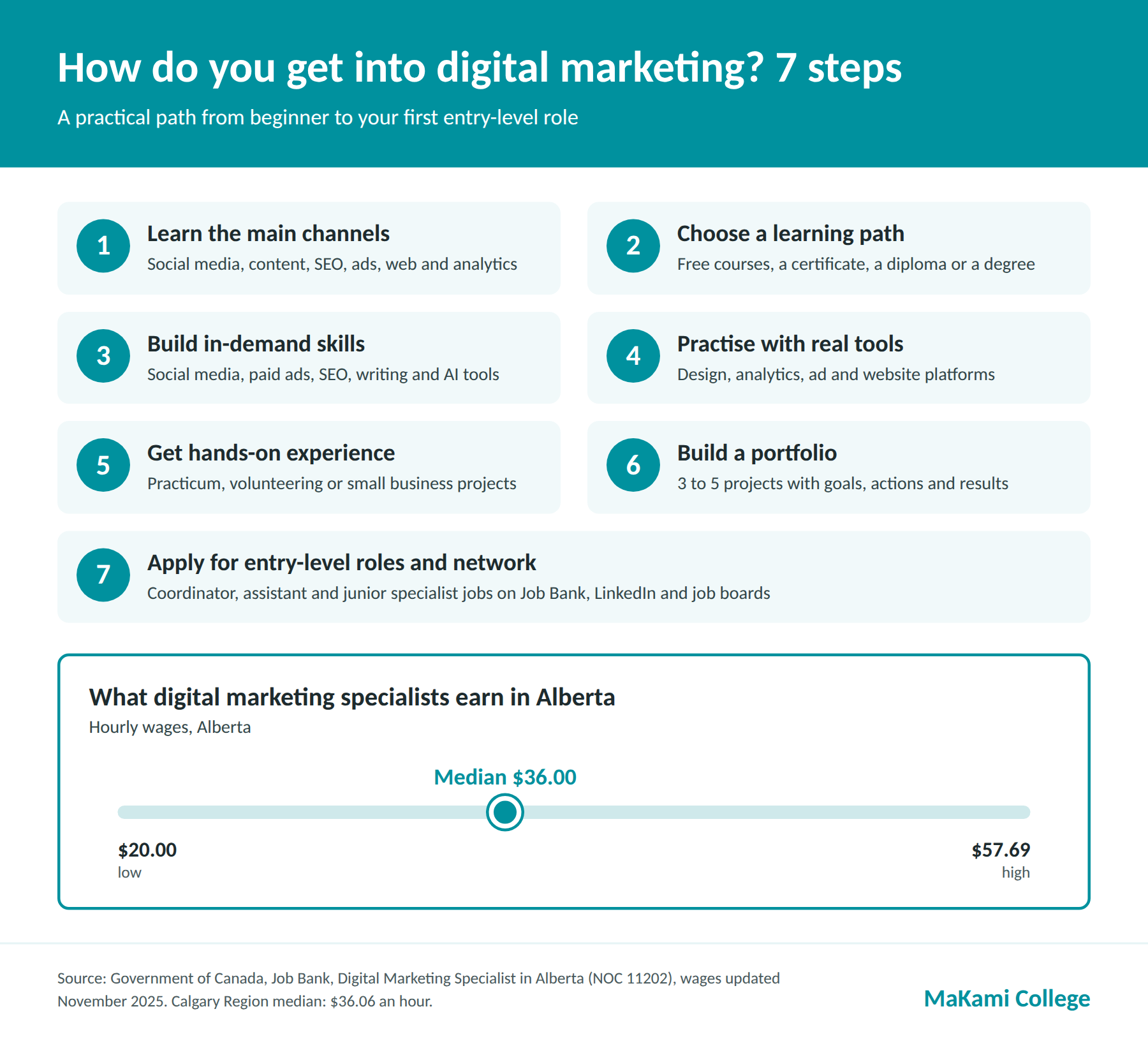
To get into digital marketing, learn how the main channels work, choose a learning path, build the skills employers screen for, practise with real tools, get hands-on experience, build a portfolio, then apply for entry-level roles. Most people move through these steps over one to two years.
Step 1: Learn how the main digital marketing channels work
Digital marketing is a group of related jobs. Knowing the main areas helps you choose where to start.
Table 1. Main areas of digital marketing and common starting roles
|
Area |
What you do |
Common starting role |
|
Social media marketing |
Plan, create and schedule posts, reply to comments and report on results |
Social media coordinator |
|
Content creation |
Produce graphics, short videos and written posts for brands |
Content coordinator or creator |
|
Search engine optimization (SEO) |
Help a website show up in Google and AI search results |
SEO coordinator |
|
Online advertising (SEM and paid social) |
Build and manage ads on Google, Meta and other platforms |
Paid media coordinator |
|
Web design |
Build and update website pages that turn visitors into customers |
Web content coordinator |
|
Analytics |
Track campaign results and turn data into decisions |
Marketing coordinator or junior analyst |
Curious how pay changes across these roles? Our guide to digital marketing salaries and career outlook in Canada breaks it down.
Step 2: Choose how you want to learn
You can teach yourself, take a short certificate, or complete a diploma or degree. Each option trades time and cost against depth and work experience. The comparison below shows which path fits which situation.
Step 3: Build the skills employers screen for
In its Digital Marketing Skills Gap in Canada report, the Digital Marketing Sector Council asked employers which skills they look for on a resume. Organic social media management came first at 71%, followed by paid social advertising and SEO at 60% each. On the soft skills side, effective written communication (72%), creativity (71%) and critical thinking (71%) led the list.
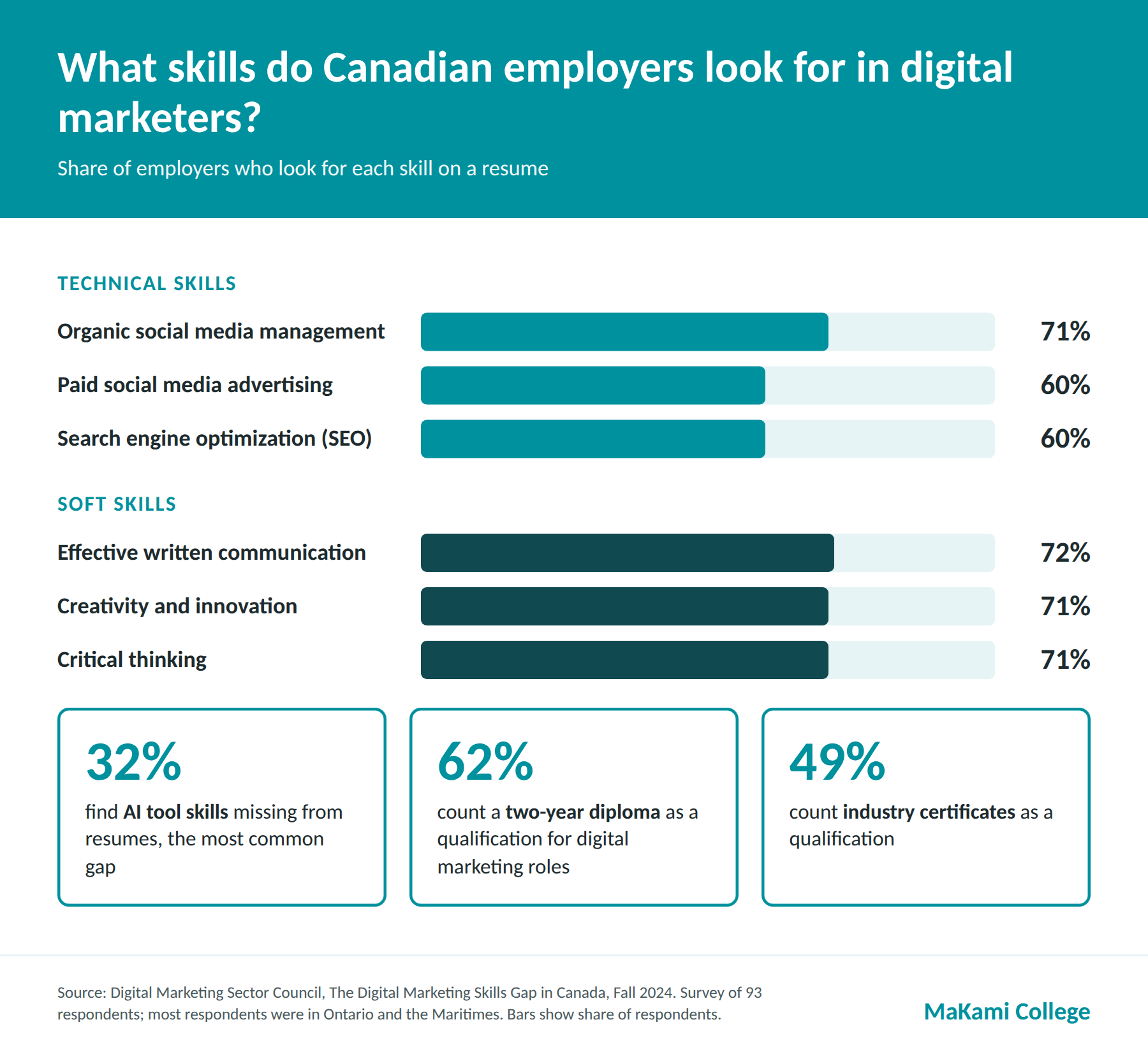
AI tool skills were the most common gap on resumes. Learning to use AI for research, first drafts and reporting, and checking its output carefully, is an easy way to stand out as a beginner.
The survey had 93 respondents, most of them in Ontario and the Maritimes, so treat the numbers as a strong signal rather than a national rule.
Step 4: Get comfortable with the core tools
You do not need to master every platform, but you should be comfortable in each main category:
- Design: Canva and Adobe tools such as Photoshop, Illustrator and InDesign
- Reporting: Excel and PowerPoint
- Social media: each platform’s business dashboard and a scheduling tool
- Websites and analytics: a website builder such as WordPress and Google Analytics
- Advertising: Google Ads and Meta’s ad tools
Free platform courses such as Google Skillshop, HubSpot Academy and Meta Blueprint are an easy way to practise and add credentials to LinkedIn.
Step 5: Get real work experience
Employers want proof that you can do the job. Good options include a practicum in your program, volunteering for a non-profit, helping a local small business with its social media, or running your own project, such as a niche Instagram account. Whatever you choose, track the numbers: reach, engagement, clicks and sign-ups.
Step 6: Build a portfolio that shows results
Three to five strong pieces are enough to start: a campaign plan with sample posts, graphics or a short video, a web page you built or improved, and a report on what you measured and changed. For each, explain the goal, what you did and what happened.
Step 7: Apply for entry-level roles and build your network
Look for coordinator, assistant and junior specialist titles on Job Bank, LinkedIn and other job boards. Tailor your resume to each posting and put your portfolio link at the top. Stay in touch with instructors, classmates and practicum supervisors, since many first jobs come through people you know.
In Alberta, Job Bank rates job prospects for digital marketing specialists as fair, with a median wage of $36.00 an hour. The median in the Calgary Region is $36.06, and wages in the Edmonton Region usually range from $20.00 to $57.69 an hour. Expect to start closer to the lower end and move up as your skills and portfolio grow.
How to learn digital marketing: which path fits you?
You can learn digital marketing through free online courses, a short continuing education certificate, a two-year diploma or a degree. Free courses are the cheapest way to test your interest. A diploma or degree takes longer but adds structure, a portfolio and, in many programs, the work experience employers look for.
Table 2. Ways to learn digital marketing compared
|
Path |
Typical time |
Work experience |
Counted as a qualification |
Trade-offs |
|
Free courses and platform certificates |
Weeks to a few months, self-paced |
No |
49% of employers (industry certificates) |
Low cost, but you must find your own projects and experience |
|
Short certificate (continuing education) |
Several months, part time |
Rarely |
Varies by employer |
Good for upskilling if you already work in business or marketing, often narrow |
|
Two-year diploma |
About 2 years |
Often, through a practicum |
62% of employers |
Bigger time commitment, broad skill set and portfolio |
|
Bachelor’s degree |
About 4 years |
Sometimes, through co-op |
69% of employers |
Most widely accepted, but the longest and most expensive route |
Source: Digital Marketing Sector Council, The Digital Marketing Skills Gap in Canada, Fall 2024. Typical times are general estimates.
If you are not sure digital marketing is for you, start with a free course before you commit. If you are changing careers and need both a credential and experience, a two-year digital marketing diploma with a practicum is often the most direct route. Many marketers combine paths: a diploma first, then certificates later to keep their skills current.
How do I become a social media manager?
Most people become a social media manager by starting as a social media or marketing coordinator, then moving into a specialist role. Job Bank lists a degree or college diploma plus several years of experience in advertising, communications or a related field for this manager-level role, so plan on a step-by-step path.
A typical path looks like this:
- Social media coordinator. Schedule posts, create content, answer comments and report on results.
- Social media or digital marketing specialist. Own channels, run paid campaigns and manage a content calendar.
- Social media manager. Set strategy, protect the brand voice, manage budgets and lead a small team or agencies.
To move from coordinator to social media marketing manager, focus on the skills that carry more responsibility: paid social advertising, analytics and clear reporting to decision makers, online reputation management, and campaign strategy. Job Bank’s requirements for social media managers are a useful checklist for where you are heading.
Start your digital marketing career at MaKami College
MaKami College is a public not-for-profit college in Alberta with campuses in Edmonton and Calgary. The two-year MaKami College digital marketing program, launched in 2026, follows the same path as this guide: core skills first, then real work experience and a portfolio.
Program at a glance
|
Detail |
Information |
|
Credential |
Diploma, 65 credits |
|
Length |
2 years (84 weeks) |
|
Delivery |
Blended and High-Flex: live and self-paced online classes, with the option to attend on campus in Edmonton or Calgary, plus an off-site practicum |
|
Work experience |
150-hour applied learning capstone with a non-profit organization and a 480-hour Digital Marketing Work Experience placement that can start at the beginning of year 2 (students secure their own placement, with support and employer contacts from the college) |
|
Career support |
Digital Marketing Career Preparation course: resumes, cover letters, interviews, portfolios and online presence |
|
Intakes |
September, January and May |
|
Admission pathways |
Standard, mature, transfer and Prior Learning Assessment and Recognition (PLAR) |
|
Funding |
Eligible students can apply for Alberta Student Aid. See our financial options. |
How the program covers each skill
|
Skill |
Courses |
|
Channels and strategy |
Introduction to Digital Marketing; Digital Marketing Trends |
|
Social media management |
Social Media Marketing Fundamentals; Advanced Social Media Marketing Strategies |
|
SEO and online advertising |
Introduction to SEO; Introduction to Online Advertising (including SEM) |
|
Design |
Graphic Design Fundamentals (Adobe Photoshop); Advanced Graphic Design Techniques (Adobe Illustrator, InDesign and Canva) |
|
Content and storytelling |
Introduction to Content Creation; Digital Storytelling and Content Strategy |
|
Websites |
Website Design Fundamentals; Advanced Website Design Techniques |
|
Analytics |
Marketing Metrics and Analysis |
|
Writing and communication |
Business Communications for Digital Marketers; Persuasive Marketing Strategies |
|
Reputation |
Online Reputation Management |
|
Experience and job search |
Non-Profit Digital Marketing Applied Learning; Digital Marketing Work Experience; Digital Marketing Career Preparation |
Who can apply
- Standard admission: at least 17 years old, an Alberta High School Diploma or equivalent, and an admission interview.
- Mature admission: at least 18 years old, with readiness shown through an interview, work or volunteer experience, an entrance exam or previous studies.
- Transfer and PLAR: credit for previous post-secondary courses, including through Transfer Alberta, or for skills gained through work or volunteering.
Applicants whose first language is not English need to show English proficiency, for example IELTS Academic 5.5 or CLB 6. Our ESL programs can help you get there.
Ready to take your first step into digital marketing?
Find out what funding you may qualify for, including Alberta Student Aid, before you apply for the September, January or May intake.
Get Pre-Approved Talk to an advisorFrequently asked questions
Not always. Job Bank says employers usually ask for a degree or college diploma in marketing, communications or a related field. In the Digital Marketing Sector Council survey, 69% of respondents counted a bachelor’s degree and 62% a two-year diploma as a qualification.
Entry-level roles can be competitive, but 58% of employers in the Digital Marketing Sector Council survey find it at least somewhat difficult to hire qualified digital marketers. Practical skills, work experience and a portfolio help you stand out.
Free online courses teach the basics in a few weeks, but becoming employable also takes hands-on experience and portfolio pieces. A structured program with a practicum combines both.
They help but are rarely required. In the Digital Marketing Sector Council survey, 49% of respondents counted industry certificates as a qualification. They work best alongside a diploma or degree and a portfolio.
Start as a social media coordinator or marketing assistant, build a portfolio, and learn paid social advertising and analytics. Job Bank lists several years of related experience for manager-level roles.
No. According to Job Bank, digital marketing is not a regulated occupation in Canada, so you do not need a licence or professional registration.
Free courses take weeks, certificates several months, and diplomas and degrees two to four years. The MaKami College Digital Marketing and Social Media Management diploma takes 84 weeks, including 480 hours of work experience.
Every digital marketing career starts with a first step. Explore the diploma and get into digital marketing with MaKami College.