
Uncategorized
10 Questions to Ask Before an Educational Assistant Program
Thinking about working in a classroom, but not as a teacher? Before starting an educational assistant program, most students want to know the same things: what the job really involves, what educational assistants earn, whether you need to be certified, and whether there is work in Alberta right now. Below are straight answers to the 10 questions students ask most, using current Government of Canada and Government of Alberta data.
Key takeaways
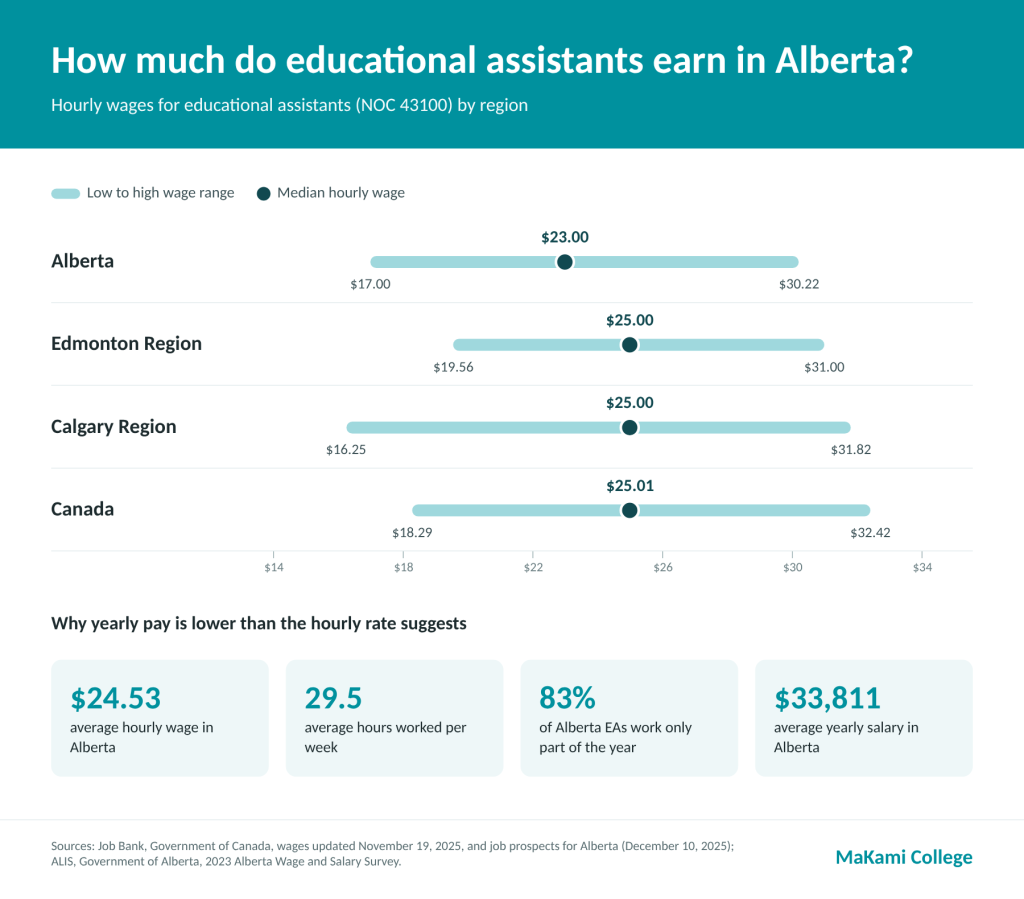
- Educational assistants (EAs) in Alberta earn a median of $23.00 an hour, and $25.00 an hour in both the Edmonton and Calgary regions (Job Bank, 2025).
- Most EA jobs follow the school year: 83% of Alberta EAs work only part of the year, so annual pay is lower than the hourly rate suggests.
- The Government of Canada rates the Alberta job outlook for EAs as Good for 2025 to 2027.
- There is no provincial licence for EAs in Alberta, but employers look for post-secondary training, background checks and first aid.
- An EA certificate can take less than a year. At MaKami College it is 42 weeks with 265 hours of work-integrated learning.
Already curious about training? See how the Educational Assistant Certificate at MaKami College is structured, or keep reading for the full picture first.
1. What is an educational assistant, and is an EA the same as a teacher?
An educational assistant is a school support worker who helps students learn under the direction of a teacher. EAs work one on one or with small groups, support students with disabilities or complex needs, help with behaviour and personal care, and prepare learning materials. An EA is not a teacher: teachers plan, teach and assess, while EAs carry out the plans.
You will also see the role called teacher assistant, teacher aide, instructional assistant or special needs educational assistant. In Canada, all of these fall under the same national occupation group, NOC 43100 (elementary and secondary school teacher assistants).
|
|
Educational assistant |
Teacher |
|
Main job |
Supports learners and carries out the teacher’s plans |
Plans lessons, teaches and assesses students |
|
Who they work with |
Often one student or a small group |
The whole class |
|
Training in Alberta |
Usually a one year certificate |
A Bachelor of Education and a teaching certificate |
|
Regulated? |
No provincial licence |
Yes, certified by Alberta Education |
Sources: ALIS Educational Assistant profile; Job Bank NOC 43100
A typical day might include reading with a student who is behind in literacy, helping a child with autism transition between activities, supervising recess, adapting a worksheet with assistive technology, and updating the teacher on a student’s progress.
2. Do you need to be a certified education assistant in Alberta?
No. Alberta has no provincial licence or registration for educational assistants. In practice, employers generally prefer applicants with an EA certificate or related post-secondary training, and many ask for a criminal record check, a child intervention record check and a current first aid certificate.
According to ALIS, “there is currently no provincial legislation regulating this occupation in Alberta,” and the usual minimum is one year of post-secondary education. Job Bank data shows 37% of Alberta EAs hold a college certificate or diploma, almost double the rate for all occupations.
When you see “certified education assistant” in a job posting, it usually means a graduate of a recognized EA program, not a government licence. That is why the program you choose matters: it is the credential employers will look at.
3. How much do educational assistants make in Alberta?
|
Most educational assistants in Alberta earn between $17.00 and $30.22 an hour, with a median of $23.00, according to Job Bank. In the Edmonton and Calgary regions the median is $25.00 an hour. Alberta’s own wage survey puts the average starting wage at $19.93 and the average top wage at $27.39. |
|
Region |
Low (per hour) |
Median (per hour) |
High (per hour) |
|
Alberta |
$17.00 |
$23.00 |
$30.22 |
|
Edmonton Region |
$19.56 |
$25.00 |
$31.00 |
|
Calgary Region |
$16.25 |
$25.00 |
$31.82 |
|
Canada |
$18.29 |
$25.01 |
$32.42 |
Source: Job Bank, Educational Assistant wages in Alberta, NOC 43100, updated November 19, 2025
|
Career stage |
Average hourly wage in Alberta |
|
Starting |
$19.93 |
|
Overall average |
$24.53 |
|
Top of scale |
$27.39 |
Source: ALIS, 2023 Alberta Wage and Salary Survey
Pay rises with experience and with the steps in your school division’s collective agreement. Roles that need extra skills, such as supporting students with complex medical or behavioural needs, may also pay more.
4. What is the yearly education assistant wage, and why is it lower than you might expect?
The average educational assistant in Alberta earns about $33,811 a year, even though the average hourly wage is $24.53. The gap comes from the school calendar: EAs average 29.5 hours a week and are paid for about 10.8 months, and most are not paid during summer break.
This is the question most salary pages skip, so it is worth being clear about:
- Most EAs work part of the year. Job Bank reports that only 17% of Alberta EAs work all year, while 83% work part of the year, for an average of 36 weeks.
- Hours are often below full time. 72% of EAs in Alberta work full time and 28% part time, and many school day positions run shorter than a 40 hour week.
- Benefits are common.6% of Alberta EAs receive at least one non-wage benefit, such as a pension plan, health and dental coverage, or paid sick days.
The upside: your schedule follows the school calendar, with evenings, weekends, winter break and summer free. Some EAs use the summer to work in camps, child care or recreation programs.
Sources: ALIS, 2023 survey; Job Bank, Alberta job prospects, updated December 10, 2025
5. Are educational assistants in demand in Alberta?
Yes. The Government of Canada rates the job outlook for educational assistants in Alberta as Good for 2025 to 2027. Employment growth, retirements and the province’s investment in support staff for complex classrooms are all adding positions, and some schools already report a shortage of EAs.
Three things are driving demand right now:
- Funding for school staff. In Budget 2025, Alberta set aside $1.1 billion to hire more school staff, including educational assistants (Job Bank).
- Classroom complexity teams. The province is funding 699 complexity teams. Kindergarten to Grade 6 teams typically include one teacher and two educational assistants (Government of Alberta).
- A moderate number of EA positions will open as current workers retire.
About 14,950 people work as EAs in Alberta, and more than 95% of them work in elementary and secondary schools.
6. Where can educational assistants work besides public schools?
Most EAs work in public, Catholic and charter schools from kindergarten to Grade 12, but EA training also leads to jobs in early learning programs, out-of-school care, adult education, disability support agencies, alternative schools, non-profits and tutoring.
Common job titles include educational assistant, teacher assistant, special needs EA, behaviour support assistant, learning support aide, EAL assistant, recreation aide and respite worker. If you enjoy working with young children, the skills overlap with early childhood education, and some graduates move between both fields.
7. What are the real challenges of being an EA?
The job is rewarding, but it is not easy. EAs often support students with intense behavioural, emotional or medical needs, may help with lifting and personal care, and usually work on school-year contracts. Patience, calm under pressure and good teamwork matter as much as academic skills.
It is better to know these before you enrol:
- Complex classrooms. In 2025, Alberta appointed an Aggression and Complexity in Schools Action Team to address growing classroom complexity. EAs are often the first support when a student is overwhelmed.
- Physical work. ALIS notes that EAs typically lift up to 10 kg and sometimes more, for example when helping students with mobility needs.
- Income planning. Summer months are usually unpaid, so you need to budget across the year.
- Advancement needs more education. Moving into teaching or specialist roles requires further study.
If you like helping one student make real progress, can stay calm when things get loud, and enjoy being part of a team, these challenges are manageable and the work can be very meaningful.
8. How long is an educational assistant program, and what will you study?
Alberta employers generally look for about one year of post-secondary training. The Educational Assistant Certificate at MaKami College takes 42 weeks and combines nine core courses, one elective and 265 hours of work-integrated learning, including two practicums.
|
Program at a glance |
Details |
|
Credential |
Educational Assistant Certificate (33 credits) |
|
Length |
42 weeks |
|
Delivery |
Blended HyFlex: on campus, live online or recorded classes |
|
Campuses |
|
|
Work-integrated learning |
265 hours: Practicum 1 (75 hours), Practicum 2 (150 hours), Applied Learning (40 hours) |
|
Key topics |
Child and adolescent development, disability awareness and assistive technology, trauma-informed practice, guiding behaviour, literacy, numeracy and EAL support, ethics and AI tools |
|
Before practicum |
Clear criminal record check and vulnerable sector check |
|
Required to graduate |
Standard First Aid and CPR-C certificate |
|
Funding |
Eligible for Alberta Student Aid |
Source: MaKami College Educational Assistant Certificate program outline, 2026
Practicum 1 lets you observe EAs in a real learning environment, and Practicum 2 gives you hands-on experience supporting diverse learners under supervision. The HyFlex format means you can attend in person, join live from home, or catch up on recordings, which helps if you work or have family commitments.
9. What do you need to apply?
Most applicants need to be at least 17, complete an admission interview, and have an Alberta high school diploma or equivalent. If you do not have a diploma, you may qualify through mature admission at 18 or older, based on work or volunteer experience, an entrance exam or previous post-secondary study.
MaKami College also considers transfer credit and prior learning assessment. If English is not your first language, you will need proof of proficiency, such as IELTS Academic 5.5 overall (no band below 5.0) or CLB 6. If you need to build your English first, our ESL program can help you get ready.
10. How can you pay for an educational assistant program?
Educational assistant training at MaKami College is eligible for Alberta Student Aid, which offers loans and grants to eligible students based on financial need. You may also qualify for other government funding, scholarships or student awards depending on your situation.
Start with an Alberta Student Aid application, then talk to our advisors about your financial options. The pre-approval process can tell you early what you may qualify for, before you commit.
Ready to see if you qualify?
Get pre-approved for the Educational Assistant Certificate at MaKami College, a public not-for-profit college with campuses in Edmonton and Calgary.
Get Pre-Approved Talk to an advisorFrequently asked questions
According to Job Bank, the high end of the national range is $32.42 an hour. In Alberta, the high end is $30.22 an hour, and up to $31.82 in the Calgary region. Experienced EAs at the top of their school division’s pay scale earn the most.
Teaching assistants and educational assistants are the same occupation in Alberta. Job Bank reports a median of $23.00 an hour province-wide and $25.00 in the Edmonton and Calgary regions.
Most do. Job Bank reports that 74.6% of EAs in Alberta receive at least one non-wage benefit, such as a pension plan, health and dental coverage, or paid leave. Benefits depend on the employer and whether the position is full or part time.
Yes, but it requires further education. To teach in Alberta you need a Bachelor of Education and an Alberta teaching certificate. Many teachers start as EAs because the experience shows them what classroom work is really like.
Often, yes. The MaKami College Educational Assistant program uses a HyFlex format, so you can attend on campus, join live online or watch recordings. Practicum hours take place during the school day, so plan for them in advance.
Start your path to the classroom
Educational assistants make inclusion possible in Alberta schools, and the province is investing in more of them. If you want hands-on training, real practicum experience and flexible classes, explore the Educational Assistant program at MaKami College or talk to an advisor about your next step.
Sources
- ALIS: Educational Assistant occupation profile, Government of Alberta (2023 Alberta Wage and Salary Survey; 2024 to 2026 forecast)
- Job Bank: Educational Assistant wages in Alberta, Government of Canada, updated November 19, 2025
- Job Bank: Educational Assistant job prospects in Alberta, Government of Canada, outlook 2025 to 2027, updated December 10, 2025
- Job Bank: Educational Assistant in Canada (NOC 43100), Government of Canada
- Taking action on classroom complexity, Government of Alberta, 2026
- Alberta Student Aid, Government of Alberta